The Problem: Why Denim Trade Shows Still Run on WhatsApp
Ask any sales director at a major denim fabric mill what happens to their buyer meeting data after Kingpins Amsterdam, and you'll hear some version of the same answer. Notes in a physical notebook. Business cards in a pocket. WhatsApp voice messages. A shared Excel file that five reps are updating simultaneously, badly. Email threads that will take three days to sort through after the show ends.
This is the state of buyer relationship management at the world's most important denim trade shows in 2026. And it's not because the mills aren't sophisticated — it's because no one has built the right tool.
General CRM platforms — Salesforce, HubSpot, even industry-adjacent tools like JOOR — weren't designed for the show floor. They don't know what a hang tag is. They don't understand that a "buyer interaction" at Kingpins means a sales rep standing next to a fabric wall, talking through 20 articles in 15 minutes. They don't capture voice notes, they don't work offline, and they don't give you article-level hit rate analytics when the show ends.
"The intelligence that drives the denim season — which articles moved buyers, which relationships converted — exists. It just doesn't survive the show floor in a usable form."— Umer Farooq Qureshi, Founder, DenimNotes
DenimNotes was built specifically to solve this. The platform started as an idea at Kingpins Amsterdam — the recognition that the most valuable data in the denim supply chain was being created and then immediately lost on the show floor. Every buyer interaction, every shortlist, every "let's discuss pricing" that becomes a sampling order that becomes bulk — it all starts with a moment that, for most mills, is never captured properly.
Pakistan's Denim Industry: The Numbers Behind the Mills
Pakistan is one of the three or four largest denim fabric producing countries on earth. The exact numbers shift with exchange rates and global demand cycles, but the range is roughly 700-800 million meters of denim fabric per year — somewhere between 15% and 22% of global production depending on the year and methodology. The main cluster is in Karachi's SITE (Sindh Industrial Trading Estate) area, with additional manufacturing in Lahore, Faisalabad, and Gujranwala.
The mills aren't competing in the commodity tier anymore — or the best of them aren't. The Pakistani denim industry has moved upstream significantly over the last decade: into ring-spun constructions, sustainable certifications, foam dyeing, laser finishing. The buyers who come to Kingpins Amsterdam from Levi's, H&M, and Zara aren't coming to find cheap denim. They're coming because Pakistani mills have built genuine technical capability at scale.
Here are the five mills we've visited in DenimNotes' supplier onboarding programme so far:
| Mill | Volume | Key Clients / Buyers | Distinction |
|---|---|---|---|
| Nishat Denim Mills | Lahore HQ · Rs.12B new plant (Faisalabad) | JACK & JONES, VERO MODA, ONLY (Best Seller A/S) | Part of Nishat Group (one of Pakistan's Big Three conglomerates); Rs.12 billion plant investment in Faisalabad 2025 |
| Naveena Denim Mills | 18M meters/year | Levi's, Zara (Inditex) | Ring-spun specialist; Blueprint 2030 sustainability programme (27% water reduction 2020-2023, OEKO-TEX Standard 100) |
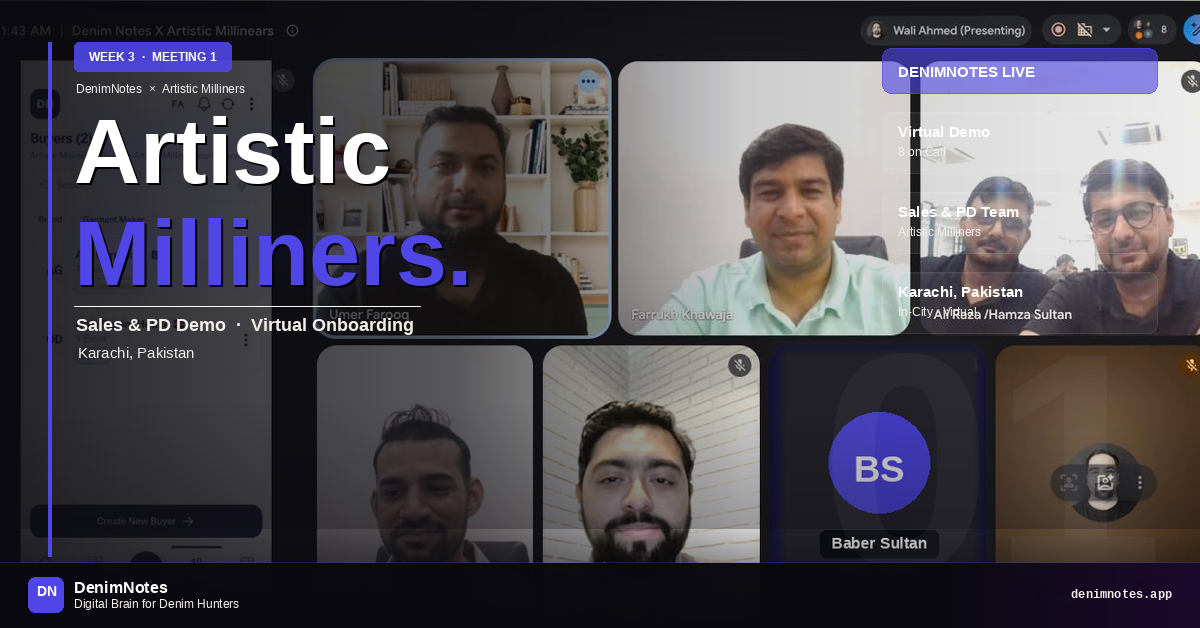
| Artistic Milliners | 108M meters/year + 30M garments | Gap, H&M, Zara | World's first Cradle to Cradle Gold certified denim manufacturer; LEED Platinum; 100MW wind farm; foam dyeing + laser finishing |
| Diamond Denim by Sapphire | 90M meters/year | International brands across US and Europe | Part of Sapphire Group (one of Pakistan's Big Three; 16,000 employees); jacquards, corduroys, specialty constructions; in-person visit July 2, 2026 |
Every one of these mills is running at a different scale, serving different client portfolios, competing on different capabilities. What they share is this: buyer meeting intelligence is being created at Kingpins Amsterdam, and it's not being captured in a form that's usable afterward. The mill that does 40 meetings in two days and walks out with a clear picture of which articles moved buyers has a genuine competitive advantage in collection planning. That mill hasn't fully existed yet, because the tool to do it hasn't existed until now.
That's what we're building.
Four Mills, Four Visits — The Onboarding Programme
Getting the right mills onto the platform before the show — not after — is the whole point. So we visited them. In person where possible, virtually where not. Each session was a structured platform walkthrough combined with a genuine conversation about how the mill's sales team operates at Kingpins: who runs the meetings, how articles are presented, what happens to the data when the show ends.
How DenimNotes Works for Denim Mill Sales Teams
The core use case for a mill at Kingpins Amsterdam is simple to describe and difficult to solve without the right tool: capture buyer meetings in real time, in a way that produces structured, queryable data that survives the chaos of the show floor.
For the Mill Sales Director: Post-Show Intelligence
The most powerful thing DenimNotes gives a mill isn't what happens during the show — it's what happens after. When every buyer interaction is captured in a structured format, the data becomes the basis for decisions that most mills currently make by instinct. Which articles from this season's collection should carry into next season? Which buyers showed real intent but haven't been followed up with? Which markets are generating the most sampling requests?
These questions have answers. DenimNotes makes those answers accessible.
DenimNotes isn't only for mills. Buyers and sourcing managers use it to scan fabric hang tags at the show with on-device OCR — in under 2 seconds — saving articles to an AI-searchable moodboard with voice notes and composition data. When a buyer connects to a mill in DenimNotes, both sides share a structured thread. The buyer's shortlist becomes the mill's priority list. Automatically.
This is the supply chain connection that DenimNotes builds — and why onboarding the right mills is the most important work we're doing right now.
What This Means for Kingpins Amsterdam 2026
Kingpins Amsterdam was founded in 2003 by Andrew Olah, who wanted a trade show that was genuinely about denim — not a general textile fair with a denim section. Twenty years later, it's the most curated denim-specific show in the world: held twice yearly at the Sugarfactory in Amsterdam, typically April and October, with editions in New York and Hong Kong as well. The format is deliberately small — 100+ exhibitors maximum — which means every brand and buyer at the show is there specifically for denim. No accidental traffic. No browsing. Every meeting counts.
The buyer-side attendance reflects that curation: 1,200+ buyers from 40+ countries, including sourcing directors from Levi's, Madewell, Tommy Hilfiger, Calvin Klein, H&M, and Inditex. For a Pakistani denim mill, Kingpins Amsterdam is the show that matters most for European and American market relationships. It's where a sampling conversation becomes a collection evaluation, and a collection evaluation becomes a bulk commitment.
DenimNotes will be on the show floor — not as an exhibitor, but as the platform that onboarded mill partners are using to structure their buyer interactions. For a mill that's been coming to Kingpins for a decade with a great collection but fragmented post-show data, the difference between this year and last year is the ability to walk out with a clear picture of what happened: which articles generated the most shortlists, which buyers are worth prioritising in follow-up, which style directions buyers were consistently asking about that weren't in the current range.
For buyers, Kingpins with DenimNotes means something different too. Instead of scanning a hang tag and losing it in a photo roll, or taking a business card you'll never match to the right article, every fabric capture goes into a structured, searchable workspace. By the time you're on the plane home, you can ask your moodboard: "Show me all the 11oz stretch fabrics I saw with a medium stonewash — ordered by how excited I was about them." That's a different kind of sourcing trip.
The supplier onboarding programme — Nishat, Naveena, Artistic Milliners, Diamond Denim by Sapphire — is the work that makes the Kingpins pilot possible. More mills are in the pipeline. If you're one of them, book a demo.
- Pakistan's denim mills are world-class in capability but fragmented in how they manage buyer relationship data at trade shows
- DenimNotes' supplier onboarding programme is bringing Naveena Denim Mills, Artistic Milliners, and others onto the platform ahead of Kingpins Amsterdam
- The platform gives mills offline-first buyer meeting capture, voice transcription, and article-level hit rate analytics after the show
- Buyers use DenimNotes to scan hang tags with OCR, build AI-searchable moodboards, and share article shortlists directly with mills
- Kingpins Amsterdam 2026 will see the first live pilot of DenimNotes as a trade show textile CRM — with committed mill partners on both the mill and buyer sides
- The supplier tier is free forever. Book a demo to get your mill ready for the next show.