Scale, and What Artistic Does With It
Artistic Milliners was founded in Karachi in 1949 — two years after Indian independence and Partition, in the early months of the Pakistani state. It started as a retail business. What it's become is harder to categorise: part denim mill, part garment manufacturer, part clean energy company, part organic cotton programme. The numbers are the easiest place to start.
108 million meters of denim fabric a year. To put that in context: the entire UK denim market — every pair of jeans sold in Britain annually — runs to roughly 150 million pieces. Artistic Milliners is producing the fabric for a significant fraction of the world's denim output, out of one integrated campus in Karachi. Their clients include Gap, H&M, and Zara. None of those brands qualify suppliers casually.
But the headline number that matters most for understanding Artistic Milliners isn't the fabric volume — it's the 30 million garments a year they produce alongside it. Most denim mills are fabric mills. They sell metres. Artistic Milliners sells metres and finished product, which means they operate both upstream (yarn, dyeing, weaving) and downstream (cutting, sewing, finishing, quality control) simultaneously. That's a fundamentally different commercial relationship with brands, and a fundamentally different level of accountability for the end product.
Foam Dyeing, Ozone Fading, and Manufacturing That's Actually Different
The most interesting thing about Artistic Milliners isn't the scale — it's the technology choices they've made and why they've made them.
Conventional denim dyeing is a water-intensive process. Rope dyeing — the traditional method for indigo — requires the yarn to be passed through multiple dyeing baths and squeeze rollers in sequence. It uses large volumes of water and chemical auxiliaries. Artistic Milliners invested in foam dyeing technology, which replaces the liquid dye bath with a foam carrier. The result: up to 90% less water consumption in the dyeing stage, significantly reduced chemical use, and comparable or better colour consistency. This isn't greenwashing — it's a capital investment in industrial equipment that produces measurably different environmental outcomes.
The same philosophy applies to their finishing operations. Conventional denim finishing — achieving the faded, worn effects that make premium denim look the way it does — historically relied on potassium permanganate spraying, sandblasting, and acid washing. All are effective. All carry health and environmental risks. Artistic Milliners has moved significant production toward ozone fading (using ozone gas rather than chemicals to achieve oxidation effects) and laser finishing (using precision lasers to create whiskers, abrasion marks, and fade patterns without any chemical contact). The output looks identical to traditional methods. The process is categorically safer and cleaner.
"Most mills talk about sustainability. Artistic Milliners has invested capital in it — foam dyeing lines, laser finishing units, ozone chambers. The infrastructure is there. That's a different conversation from a commitment document."— Umer Farooq Qureshi, Founder, DenimNotes
C2C Gold, LEED Platinum, and Why the Certifications Are Real
Artistic Milliners holds the Cradle to Cradle Gold certification — making them the world's first denim manufacturer to reach that level. C2C is not a simple standard. It evaluates products across five categories: material health, material reutilisation, renewable energy and carbon management, water stewardship, and social fairness. Gold certification requires meeting minimum thresholds across all five and exceeding them in several. It's independently audited and time-limited — you have to re-certify, which means the performance has to be maintained, not just achieved once.
Their ArtMill facility carries LEED Platinum — the highest tier of the Leadership in Energy and Environmental Design standard, which evaluates building performance across energy use, water efficiency, indoor environment quality, and sustainable site development. LEED Platinum is uncommon in any industry. In the Pakistani textile sector, it's exceptional.
The energy numbers are equally significant. Their 100MW wind farm generates approximately 1.3 billion kWh of clean electricity annually, feeding into Pakistan's national grid. They operate a further 12+ MW of solar. For a manufacturing operation with the energy demands of integrated spinning, dyeing, weaving, and garment production, generating more renewable energy than you consume isn't a PR exercise — it's a genuine net-positive contribution to the grid.
Their Milliner Organic programme develops domestic organic cotton farming across Balochistan, with all programme farms reaching organic certification. Combined with their Alliance for Water Stewardship certification and their status as one of the few globally Fair Trade Certified denim manufacturers, Artistic Milliners represents something genuinely rare: a large-scale manufacturer where the sustainability credentials are backed by third-party audits, capital investment, and measurable outcomes.
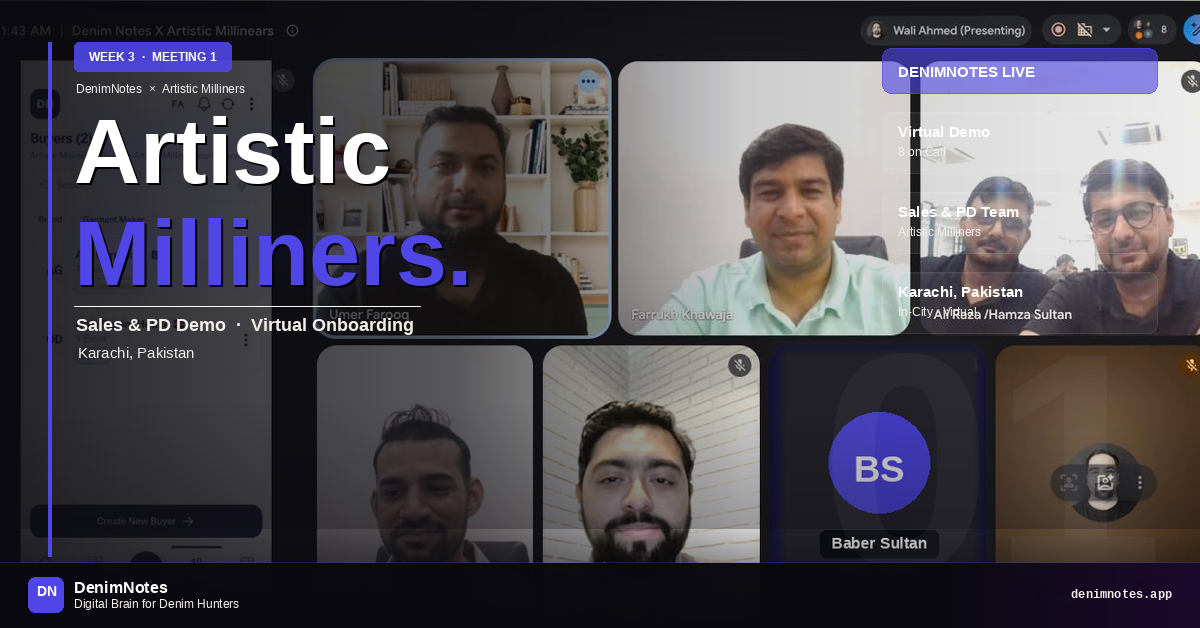
Eight People on the Call
When a company sends eight people to an introductory call, it tells you something. Either they're very thorough, or they're genuinely interested. With Artistic Milliners, it was both.
The DenimNotes team connected with the Artistic team on a Google Meet — Lahore to Karachi, Week 3 of building in public. On their side: a mix of commercial leadership, sales team members who would actually be using the platform at Kingpins, and technical stakeholders who wanted to understand how the data architecture worked. That combination — decision makers and end users in the same call — is actually the right configuration for evaluating a tool. The commercial team can assess ROI. The sales reps can immediately flag whether the workflow makes sense in practice.
We ran through the platform properly. The hang tag OCR scan — under two seconds from camera to saved article. The voice note capture that transcribes automatically on the show floor, offline. The buyer workspace where shortlisted fabrics and feedback accumulate into a structured post-show record. For a mill bringing 80-100 articles to Kingpins across multiple fabric families (stretch, rigid, crosshatch, broken twill, specialty finishes), the ability to track exactly which articles resonated with which buyers in real time isn't just useful — it changes how you plan the following season.
The Artistic team's questions shifted partway through the demo. They started asking about buyer privacy — specifically how the platform ensures a buyer's price or sourcing strategy can't be seen by the mill. That's the right question. It tells you they were thinking about adoption from the buyer's perspective, not just their own.
The answer: buyer pricing is encrypted at workspace level and never shared with mills under any circumstances. Mills see which articles generated interest and the buyer's feedback. They don't see what the buyer paid anyone else for anything.
What They Responded To
The most honest account of what happened in this meeting is that Artistic Milliners didn't fall in love with a feature — they responded to a problem statement.
Every mill at their level has the same structural issue. They show up to Kingpins Amsterdam with a serious collection, a well-prepared sales team, and two days of scheduled and unscheduled buyer meetings. Those meetings generate an enormous amount of signal: which articles are landing, which aren't, what buyers are asking for that isn't in the current range, which relationships are warm and which have gone cold. None of that signal is being systematically captured. It fragments into notebooks, WhatsApp threads, and end-of-day memory dumps.
DenimNotes is built to capture that signal as it happens. Not a post-show debrief. Not a WhatsApp summary. A structured, searchable, article-level record of every buyer interaction — captured in real time on the show floor, offline if necessary. The Artistic team understood immediately what that would mean for their post-show follow-up and their collection planning process.
They committed to testing it at Kingpins. And more valuably, they committed to sharing what they learn — what works, what doesn't, what they wished the platform did differently. For a platform in early development, that kind of feedback from a mill at this level is genuinely irreplaceable.
Kingpins Amsterdam: Testing Under Live Conditions
Kingpins Amsterdam is the right test. The Sugarfactory venue in Amsterdam is small, curated, and packed. There's no way to hide behind a large booth or rely on foot traffic to do the selling. Every exhibitor is visible. The wifi is show-floor wifi. Buyers move quickly. The two-day window is genuinely finite.
Artistic Milliners is a fixture at Kingpins — their booth draws buyers who know the collection and return to it seasonally. That means the testing conditions are real: genuine buyer relationships, real article evaluations, actual sampling discussions. Not a simulated demo environment.
If DenimNotes can capture what happens in those conversations — the articles that get picked up, the feedback that gets given, the buyers who say "I need this in a lighter weight" or "can you do this wash on a BCI cotton base?" — and turn it into structured data that the Artistic team can actually use in their follow-up and planning, that's the platform working as designed.
Artistic Milliners is in the DenimNotes network. If you're a denim fabric mill preparing for Kingpins or any major sourcing show, book a demo — the supplier tier is free and the setup is designed to fit around how mills already work.
- Artistic Milliners' technology choices (foam dyeing, ozone finishing, laser) represent capital investment in environmental outcomes — not marketing commitments
- C2C Gold certification is independently audited and time-limited — it has to be maintained, not just achieved once
- Eight-person call with both commercial and end-user stakeholders — they were evaluating seriously, not just being polite
- The buyer privacy question (how does the mill not see what the buyer paid?) was the right question — it signals they're thinking about adoption from both sides
- They're testing DenimNotes at Kingpins Amsterdam and sharing their feedback — the most valuable kind of early partnership