What Makes Naveena Different
Founded in 2003, Naveena Denim Mills sits in the part of Karachi's SITE industrial area that most buyers never visit but absolutely depend on. Their facility is what people in the trade call "vertically integrated" — but that phrase gets thrown around so loosely it's almost lost its meaning. At Naveena it means something specific: ring-spinning, rope dyeing, weaving, finishing, and quality control all happen on one campus, under one roof, with one chain of accountability.
That chain of accountability matters when your clients are Levi's and Zara. Both run supplier audits that would humble most factories. Levi's Restricted Substances List alone covers over 150 chemical compounds. Zara's Join Life standard requires documented environmental controls at every production stage. Naveena passes these audits — not just once, but consistently, which is the harder test.
Their sales presence spans Pakistan, USA, UK, Spain, Turkey, and Bangladesh. That footprint isn't there by accident; it reflects where the sourcing decisions are actually being made and who they need people in the room with. For DenimNotes, Naveena represented exactly the kind of internationally oriented mill the platform was designed for — serious buyers, serious shows, serious need for better data.
Ring-Spun Denim and Why It Matters
Most people who wear jeans don't know the difference between ring-spun and open-end (OE) spun denim. The factories that produce it know it very well, and so do the buyers sourcing it.
Open-end spinning is faster and cheaper. The yarn it produces is rounder, more uniform, slightly harsh to the hand. It's perfectly suitable for basic denim and it's what most commodity-tier production runs on. Ring-spun yarn is different. The spinning process imparts a natural twist that creates an irregular, slightly hairy surface — that characteristic "slub" texture that gives premium denim its tactile interest and the slight visual texture that's especially visible after washing.
Naveena's emphasis on ring-spun production is a deliberate positioning decision. It places them above commodity denim and squarely in the premium segment where brands like Levi's and premium Inditex labels (Zara, Massimo Dutti) source. It also means their fabric handles and ages differently — the indigo fading on ring-spun denim is richer and more irregular, which is exactly what the market at the top of the price curve is asking for.
"The brands who buy ring-spun denim aren't looking for the cheapest metre. They're looking for the article that photographs well, wears in beautifully, and gets the consumer to pay the price point. That's what Naveena is producing."— Umer Farooq Qureshi, Founder, DenimNotes
What the Naveena Team Told Us
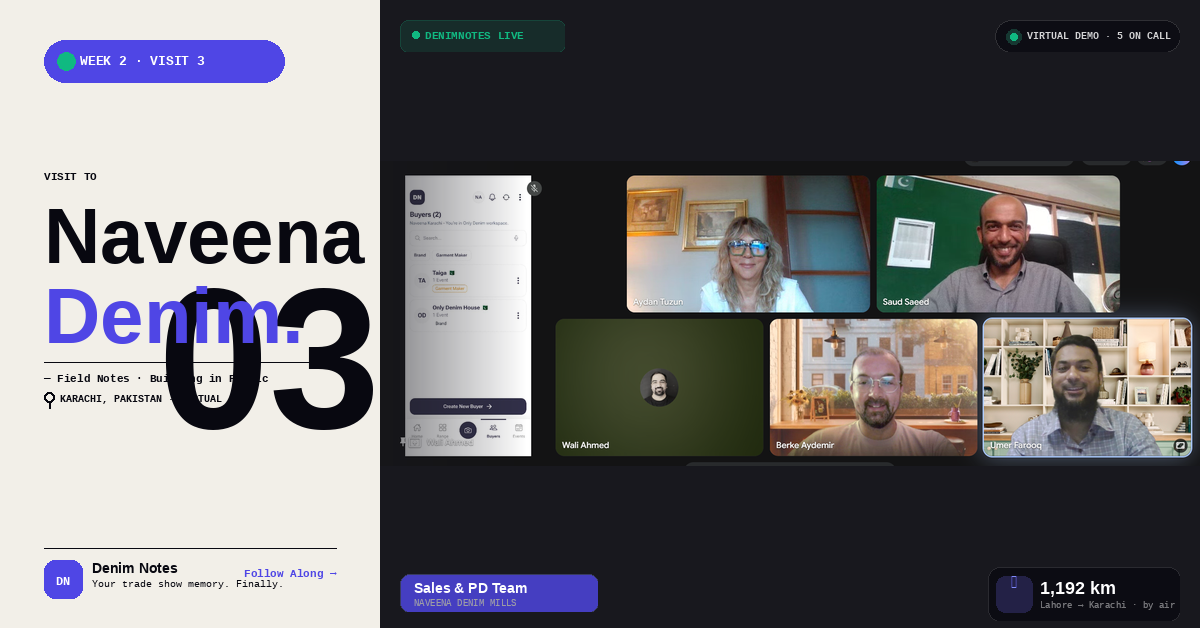
Our call with Naveena's team happened over Google Meet — five people, Lahore to Karachi, 1,192 km apart. This was Week 2 of building DenimNotes in public, our third actual conversation with their team, and the one where we stopped explaining the product and started asking them about their problems.
The Naveena sales team is not unsophisticated. They've been selling internationally for years. They know how to handle buyers, how to present a collection, how to manage the pre-show preparation that takes weeks. The issue they described wasn't about sales capability — it was about information capture.
At Kingpins Amsterdam, a Naveena sales rep might sit through 40 buyer meetings in two days. In each one, they're showing a collection that could run 80–120 articles across different weights, constructions, and washes. A buyer picks up an article, says something — "I like this but the weight is too heavy for what we're doing in spring, do you have this in a 9oz?" — and then moves on. That comment is gone. The rep remembers it for a day, maybe two, then the show ends and the reconstruction begins.
Kingpins Amsterdam typically draws 1,200+ buyers from 40+ countries across two days. A mill with a mid-size booth handles between 30 and 60 buyer meetings per edition. If the average meeting covers 10–15 articles, that's 450–900 individual article interactions per show — almost none of which are systematically recorded in the moment.
Post-show, most mills rely on a combination of scribbled notes and rep memory to reconstruct what happened. DenimNotes captures it as it happens, so the post-show analysis is automatic rather than archaeological.
The Show Floor Problem Nobody Talks About
There's a version of this problem that mills acknowledge openly, and a version that's harder to admit. The easy version: "We lose track of feedback at shows." True, and fixable with a better tool.
The harder version: mills don't actually know which articles in their collection are working. They know which ones convert to bulk orders, eventually, six months later. But they don't know which ones consistently generate interest and get dropped for reasons outside the mill's control (buyer budget cuts, brand direction changes, internal politics). And they don't know which ones nobody picks up, so they keep showing them season after season hoping something will shift.
That's what article-level hit rate data actually solves. Not just "did this buyer follow up?" but "across 60 buyers over three show seasons, this article was shortlisted 41 times, sampled 18 times, and converted to bulk 3 times — and here's the pattern in who converted and who didn't." That's actionable intelligence for the design and commercial team when they sit down to plan the next collection.
Naveena understood this immediately. They've been doing this long enough to know what a difference it would make.
Blueprint 2030: Sustainability with Teeth
Naveena's Blueprint 2030 programme isn't a marketing document — it's a structured commitment to measurable environmental targets. Between 2020 and 2023, they reduced water consumption per metre of fabric by 27%. Their target is 70% wastewater recycling by 2030. They're pursuing OEKO-TEX Standard 100 certification across their product range — the most widely recognised consumer-facing guarantee that fabric has been tested for harmful substances at every production stage.
This matters more now than it did five years ago. The brands Naveena supplies — Levi's in particular — have made public commitments to sourcing from suppliers with documented environmental programmes. Levi's Water<Less initiative and its Screened Chemistry programme both create commercial incentive for mills that can show real numbers, not aspirational targets.
For DenimNotes, sustainability credentials are data the platform wants to surface. When a buyer is shortlisting fabrics, knowing that a particular mill is OEKO-TEX certified, operates on recycled water, and can prove it with third-party documentation changes the conversation from "which fabric do I like?" to "which fabric do I like that I can also put in front of my sustainability team?" Those are different decisions, and the second one is increasingly the one being made.
Kingpins Amsterdam and What's at Stake
Kingpins Amsterdam is not a typical trade show. It was founded in 2003 by Andrew Olah — the same year Naveena was established — and has grown into the most curated, most influential platform in the global denim fabric trade. The venue matters: the Sugarfactory in Amsterdam is small enough that you can't hide. Every exhibitor is visible. Every buyer passes through the same space. There's no carpeted convention hall anonymity.
For a Pakistani mill, the April and October editions of Kingpins are where European season decisions get made. A good Kingpins can set a mill up for six months of follow-up. A poor one — too many missed conversations, articles that didn't land, follow-up that came three weeks late — can mean the season is already gone before it starts.
DenimNotes was built specifically for this environment. It works offline, because the Sugarfactory's wifi on show day is the kind of thing you don't rely on. It captures by voice, because a sales rep with fabric samples in one hand and a buyer's attention in the other can't type. And it produces post-show intelligence automatically, so the week after Kingpins is spent on qualified follow-up rather than trying to figure out who said what to whom.
Naveena Denim Mills is in the DenimNotes network. If you're a denim fabric mill preparing for Kingpins or any other major show, book a walkthrough — it's free for mills, and the setup takes less time than one post-show debrief meeting.