Siddiqsons Group: Who They Are
Siddiqsons Group is one of Pakistan's established textile conglomerates, with their denim division — Siddiqsons Denim — among the country's respected fabric manufacturers. Based in Karachi, they supply high-quality denim fabrics to international brands across Europe and North America. Their sales team works with buyers from some of the world's most demanding fashion groups, which means they understand precisely what commercial rigour looks like from the customer's side of the table.
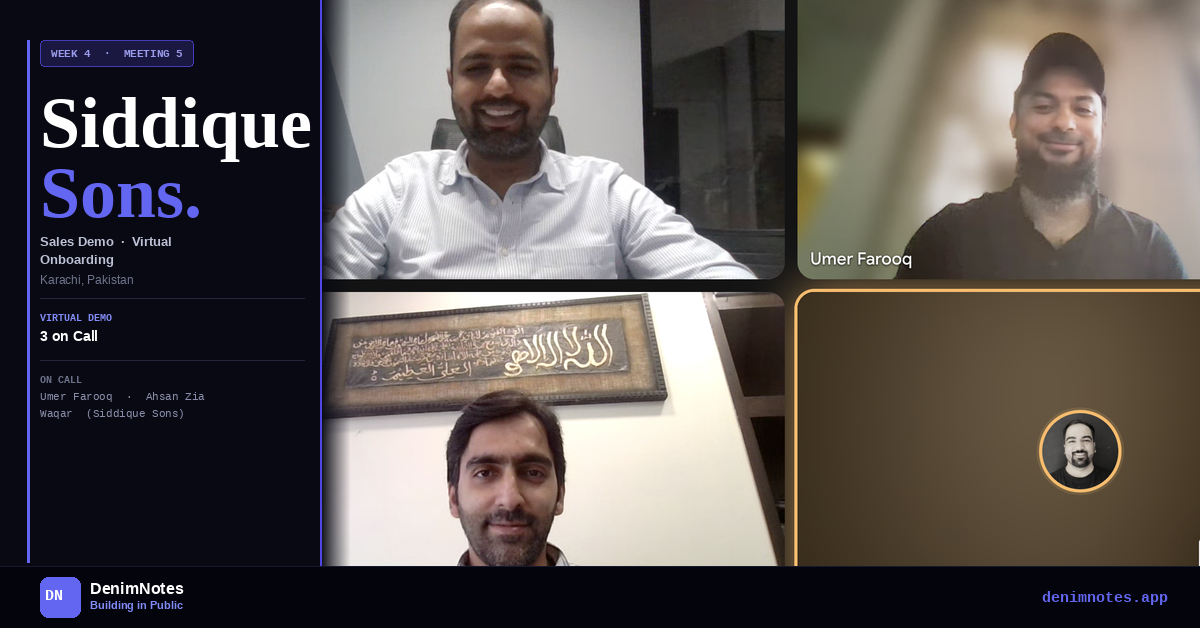
Ahsan Zia Khanzada leads on the commercial side. Waqar is part of the Siddiqsons team. Both joined the call for Week 4, Meeting 5 of DenimNotes' Building in Public series. But the conversation had already started — before either side had formally introduced itself — in a message that I didn't expect.
The Reply That Made Our Day
When you reach out to a mill to invite them for a product demo, you usually get one of three responses. A polite "we'll have a look." A request to know more before committing to a call. Or silence — the most common outcome in cold outreach to busy sales teams.
Ahsan's response was none of these. Before I could explain what DenimNotes does, before I'd sent a deck or a video or a feature list, he replied with this:
"One of the biggest challenges our industry faces is the lack of transparency, traceability, and a unified approach to product development. Too much valuable information is scattered across emails, chats, and individual systems, making it difficult to build ownership and make data-driven decisions. Any initiative that brings all stakeholders onto a common collaborative platform is certainly a step in the right direction."— Ahsan Zia Khanzada, Siddiqsons Group
Read that again. Transparency. Traceability. Unified product development. Information scattered across emails, chats, and individual systems. Common collaborative platform. That is the DenimNotes value proposition, almost verbatim, written by someone who had never seen the product.
That message made my day. Not because it was flattering. Because it confirmed, from a serious commercial professional at a serious mill, that the problem we're solving is not an edge case or a niche concern. It's a widely-felt, named, articulated pain that the industry is actively looking for solutions to.
Stepping on a Nerve
I've had a lot of conversations with fabric mills over the past four weeks of building in public. The specifics vary — different mill sizes, different markets, different levels of digital maturity. But the underlying frustration is structurally identical across all of them.
Information is everywhere and nowhere at the same time. A buyer selects an article at a show. That selection lives in a WhatsApp message. The follow-up discussion lives in an email chain. The price negotiation happens on a call that nobody recorded. The development update is in a spreadsheet that the PD team maintains but sales can't access. By the time the fabric actually makes it to bulk, reconstructing the commercial history of that article requires piecing together five different sources — if those sources still exist.
This is the nerve Ahsan named. And it's the nerve DenimNotes was built to address.
When the person you're pitching articulates your value proposition more precisely than your marketing does, before the pitch begins, it tells you one thing: the market is ready. The problem is not theoretical. The buyer has already formed the concept. They just haven't found the product yet.
That's the best possible position to be in. It means the conversation can skip the "why this matters" phase and go straight to "how does it work."
What We Talked About
The call itself had the energy you'd expect from that kind of opening. Ahsan and Waqar were already primed. They had already framed the problem themselves. What they wanted to see was whether DenimNotes actually solved it — specifically and practically, not in the abstract.
We walked through the platform the way we always do: starting with the article, not the feature. An article in DenimNotes isn't just a record. It's a thread. Everything that has ever been discussed about that fabric — buyer interest, price negotiations, MOQ discussions, development stages, internal notes, external feedback — lives on that thread, visible to everyone who needs to see it, from the sales rep on the road to the management team in the office.
We talked about what happens at trade shows. A buyer walks into the Siddiqsons booth at Kingpins. They pick up an article. They ask about price, about lead time, about minimum order quantity. That conversation, in the current world, gets written in a notebook or typed into a WhatsApp group. In DenimNotes, it's captured directly on the article — the buyer's name, what they said, what stage they're at, what the agreed follow-up is. Offline. In real time. Searchable six months later.
We talked about what happens when a buyer follows up after the show. The current experience: the sales rep digs through messages, calls a colleague, asks PD for the development status, tries to piece together a coherent answer. The DenimNotes experience: open the article, see the complete history, reply in under two minutes with accurate information.
The Missing Accountability Layer
One of the most honest conversations in this call was about management expectations and the accountability gap that exists in almost every mill's commercial operation.
Management has expectations of sales teams that are entirely reasonable: show us how much effort you're putting in for your customers. Show us which accounts are active. Show us the conversion rate from article selection to sampling to bulk. Show us where we're winning and where we're losing. These are not unreasonable questions. They're exactly the questions a well-run business should be asking.
The problem is that there is currently no system at the fabric mill level that can answer them. The information to answer them exists — it's distributed across individual inboxes, phone memories, and personal notebooks. But there's no aggregated, visible record of how much the sales team spent and worked for their customers, from the first article selection through to bulk confirmation.
This isn't a failure of sales teams. It's a failure of infrastructure. You cannot measure what you don't systematically capture. And the denim fabric industry, as a whole, has not had a purpose-built system for capturing this data at the article level — until now.
In the age of AI, having a platform that captures all stages of the commercial journey and acts as your assistant — that lives in your phone, that works offline at trade shows, that gives management visibility without requiring anyone to manually compile reports — is something every denim fabric sales professional needs. The mills that build this infrastructure today will have a measurable advantage in how they serve buyers, how they plan collections, and how they demonstrate value to the accounts they work hardest for.
"In the age of AI, having a platform that captures all stages and acts as your assistant — one that lives in your phone — is something every denim fabric sales person needs."— Umer Farooq Qureshi, Founder, DenimNotes
Testing, Feedback, and What Comes Next
Siddiqsons are taking DenimNotes for a test run. They'll be using it in their actual commercial workflow — logging buyer conversations, tracking article status, testing the management visibility layer against the reality of how their sales team operates. Their feedback will shape what gets built next.
That's the whole point of Building in Public. We are not building in a vacuum. We are building alongside the mills and buyers who will actually use the platform — people who understand the problem from the inside, who have strong opinions about what good looks like, and who have enough commercial context to tell us when we've got something right and when we've missed.
Ahsan Zia proved that in his very first message. The smiles on the call confirmed it. This is one of the conversations I'll be thinking about as we build the next version of the platform.
If you're a denim fabric mill or buyer who recognised yourself in any of the problems described here, book a demo. The mill tier is free for early partners. The only thing we ask in return is honest feedback.
- Ahsan's reply — written before the demo, without having seen the product — mapped DenimNotes' value proposition almost exactly: transparency, traceability, unified product development, information scattered across systems
- The pain is not niche. When a serious commercial professional at a respected mill names the problem unprompted, it tells you the market is ready
- The accountability gap is real: management has legitimate questions about sales effort and conversion that current mill infrastructure cannot answer
- Tracking from initial article selection to bulk is the workflow DenimNotes was designed for — and it's the workflow that is currently most broken across the industry
- Siddiqsons are testing the platform and sharing feedback — the kind of early partner that shapes a product in ways that no internal team can replicate