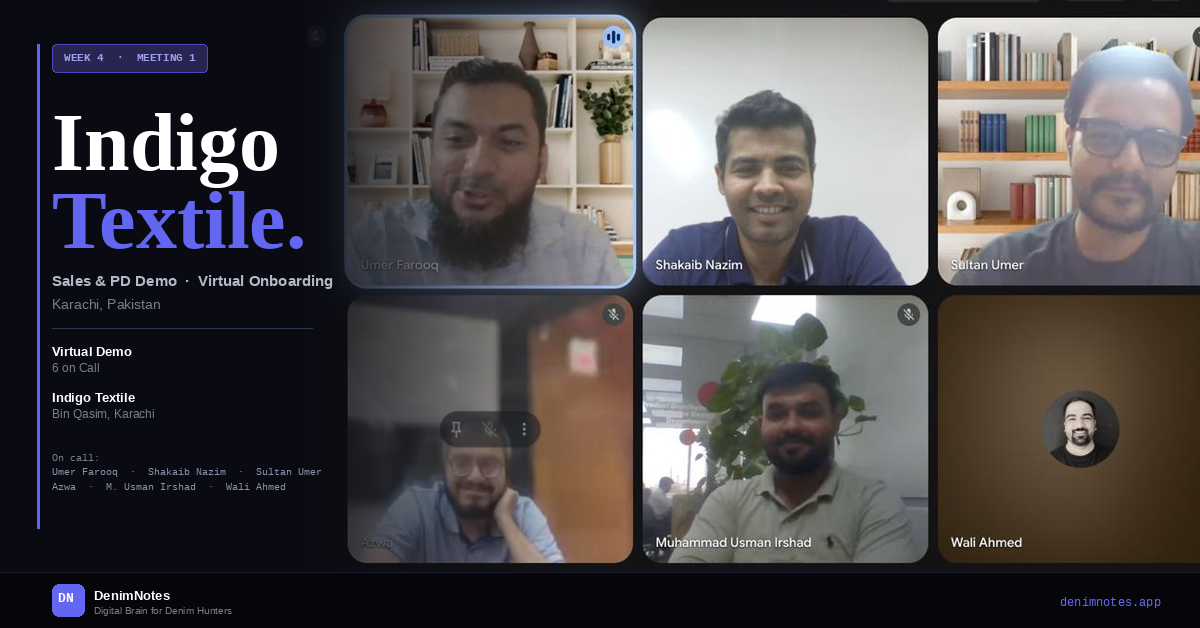
Who Is Indigo Textile
Indigo Textile (Pvt) Ltd is a Karachi-based denim fabric manufacturer operating out of Bin Qasim — Pakistan's industrial port zone and one of the most active manufacturing corridors in the country. They position themselves as a one-stop denim destination: a mill that can handle the full breadth of what a serious buyer or brand needs from a single fabric supplier, from indigo weaves to specialist finishes, with a commercial setup built for international markets.
What makes Indigo Textile interesting isn't just what they produce — it's how they think. In a sector where many mill teams still operate on paper samples, printed lookbooks, and WhatsApp as the primary communication layer, the team at Indigo had already started asking whether there was a better way. Not because someone above them told them to look. Because they felt the friction themselves, every day, in the way information moved — or failed to move — between sales, product development, and management.
That's a different starting point for a conversation.
They Were Already Looking
The best validation a product can receive isn't a paid subscription or a glowing review. It's meeting a team that was independently trying to solve the same problem — without the tools to do it properly.
When we connected with Shakaib Nazim, Sultan Umar, and Usman Rajput at Indigo, we quickly learned that the DenimNotes demo wasn't landing on blank ground. They had been internally exploring what a tracking system could look like. Spreadsheets, shared drives, internal WhatsApp groups — the usual improvised infrastructure that mills build when they know something is missing but can't find the right solution.
The problem with improvised infrastructure is that it doesn't scale, doesn't give management visibility, and doesn't survive personnel changes. When the person who maintains the spreadsheet goes on leave, the entire system stalls. When a buyer follows up on an article discussed six weeks ago in a trade show conversation, nobody can find the original notes. When management asks for a status update on articles in development, the answer requires three people, two WhatsApp threads, and a call.
The Problem Every Mill Knows
There is a specific kind of pain that runs through every fabric mill sales team, regardless of size or geography. It goes like this.
An article gets selected by a buyer at a trade show or showroom meeting. The sales rep logs it — somewhere. Maybe a notebook, maybe a WhatsApp message to themselves, maybe a note in their phone. The article goes into development. The PD team has their own tracking. The sales team has theirs. Management has neither — they have to ask.
Weeks later, the buyer follows up. Which article was it? What price was discussed? What was the lead time quoted? What stage is development at? The answers exist — fragmented across inboxes, chats, and memory. The time spent reconstructing that information is time not spent selling.
The Indigo team described this exactly. Articles slipping through conversations. PD and Sales working in silos where the left hand doesn't know what the right hand is doing. Management asking for updates that should already be visible as a matter of system design, not individual effort.
"Articles slipping through conversations. PD and Sales working in silos. Management asking for updates that should already be visible. Sound familiar to everyone at a denim mill I talk to."— Umer Farooq Qureshi, Founder, DenimNotes
This is not an Indigo Textile problem. It is an industry-wide infrastructure problem that the denim supply chain has normalised because there was no purpose-built alternative. Until now.
What We Walked Them Through
The DenimNotes demo for Indigo covered the full picture — not just one feature, but how the system works as a connected whole.
We started with the Range view: a shared workspace where Sales and PD both live. Every article the mill carries has its own thread — article number, composition, weight, weight in oz, finish, images, buyer interest history, price and MOQ discussions, development status, and all related communications. The same article, the same data, visible to sales reps on the show floor and PD leads back at the mill simultaneously.
Then we showed how buyers shortlist and select. In the current model at most mills, a buyer expressing interest generates a WhatsApp message, an email, or a verbal confirmation that gets written down somewhere. In DenimNotes, a buyer's shortlist and selection are captured as structured data — attached to the article, timestamped, linked to the buyer's profile. When management wants to know which articles have buyer interest and at what stage, the answer is one screen, not three phone calls.
We then walked through article-level tracking from selection to bulk: how the conversation, the prices discussed, the MOQs, the lead times, the delivery terms all live attached to the article thread rather than buried in an inbox. When a buyer follows up in six weeks, the sales rep has the complete picture in their phone in seconds.
During the session we loaded two articles into the Indigo workspace. PSTF-182 — an Indigo 12.5oz article — went in with Shortlisted status. GIFFORD went in as Selected, with two buyers already attached. Seeing your own articles in the system, with real statuses, in real time, changes the conversation from abstract to concrete immediately.
What Clicked Immediately
The Indigo team didn't need long explanations. That's the tell.
When you demo a product to someone who hasn't thought about the problem, you spend most of your time on context — explaining why this matters, why the current way is broken, why something different would be better. When you demo to someone who has already felt the pain and already tried to patch it themselves, you spend your time on specifics: how exactly does this work, what happens when X, can you show me Y?
Shakaib, Sultan, and Usman were asking the second kind of questions almost immediately. How does the app handle a buyer who selects multiple articles across different meetings? How does a mill sales rep on a trade show floor add an article without internet access? How does management get their birds-eye view without having to log in every time someone updates something?
These are the questions of people who already think in systems. Who already understand what good would look like, because they've been trying to build a version of it themselves with the tools they had.
The Next Generation of Mill Teams
What struck me about the Indigo team wasn't just that they got it quickly. It was why they got it quickly.
The denim supply chain has been running on personal relationships, verbal agreements, and paper-based processes for decades. Those processes aren't broken because the people running them are careless — they're broken because there were no better tools purpose-built for this specific workflow. Everybody adapted. Everybody improvised. And the improvised systems became the standard.
The next generation of mill teams — young people who grew up with smartphones, who use Notion for personal productivity and expect software to behave the way modern software behaves — look at those improvised systems and immediately see their limits. They're not wrong. They're just ahead of the infrastructure.
Young, tech-savvy teams like Indigo's are the ones reshaping how this industry will operate. They're not waiting for a top-down digital transformation mandate. They're building upward pressure from the sales floor. I genuinely believe the mills that invest in better tools today will be the ones buyers want to work with tomorrow. Not because buyers are demanding it yet — but because the operational advantage compounds over time.
The mill that can tell a buyer exactly which of their articles have been shortlisted by similar buyers, what price point generated the most interest, and what the current development status is for every active article — that mill runs faster, follows up better, and converts more.
Indigo is taking DenimNotes for a test run. Their feedback will shape what we build next. I'm looking forward to this one.
- The team had been independently exploring internal tracking tools — the strongest possible signal that the problem is real and felt
- Articles slipping through conversations and PD/Sales silos are universal complaints across every mill DenimNotes has onboarded so far
- They asked operational questions immediately — a sign they were thinking in systems, not just evaluating a feature list
- PSTF-182 and GIFFORD went live in their workspace during the call — seeing your own articles with real statuses changes the demo from abstract to concrete
- Young, tech-savvy mill teams are the ones creating upward pressure for better tools — the industry's digital shift will be driven from the sales floor up