Neela by Sapphire: Where It Started
Neela by Sapphire Fibres is the denim division of the Sapphire Group — one of Pakistan's most respected textile conglomerates. They produce high-quality denim fabrics, operate with a full Sales and Product Development team, and have the kind of commercial depth that comes from being part of a group that has been in textiles for decades.
But Neela isn't just another mill on the Building in Public list. It's the place where I first fell in love with denim. A lot of what became DenimNotes — the specific problems it solves, the workflows it's built around, the features that matter most to a mill sales team — came from watching how things worked at Neela. And how they sometimes didn't.
The Information Asymmetry Problem
When you work inside a mill, information stops at department walls. Sales knows what buyers asked for at the show. PD knows what's in the development pipeline. R&D knows what's technically feasible. Management wants to understand the commercial picture across all three. None of them are looking at the same information at the same time.
Sales has conversations PD doesn't hear. PD makes decisions sales doesn't know about until a buyer asks a question they can't answer. Management gets summaries of summaries — by the time information reaches the top, it's already been filtered, delayed, and partially lost. I watched this at Neela, not once but constantly.
"Every mill I've spoken to over these twenty meetings wants the same thing: their sales team focused on the customer, not chasing updates. That's what this solves."— Umer Farooq Qureshi, Founder, DenimNotes
This is the problem I watched at Neela. It wasn't unique to them — it's structural across the industry. But seeing it from the inside, understanding exactly where the gaps were and why they existed, gave me a level of specificity about the problem that I couldn't have gotten any other way. DenimNotes is built around those gaps. The real-time information sharing, the article-level thread, the management visibility layer — each of these features exists because of something specific I observed about how information moves (and fails to move) inside a mill.
The best products built for an industry are built by people who have worked inside it. Not consulted for it. Not studied it from the outside. Worked inside it — and felt the friction personally. That friction is the product brief. Every feature in DenimNotes has a corresponding moment of frustration from inside a real mill operation. Neela is where many of those moments happened.
Meeting 20: The Full Team, In the Room
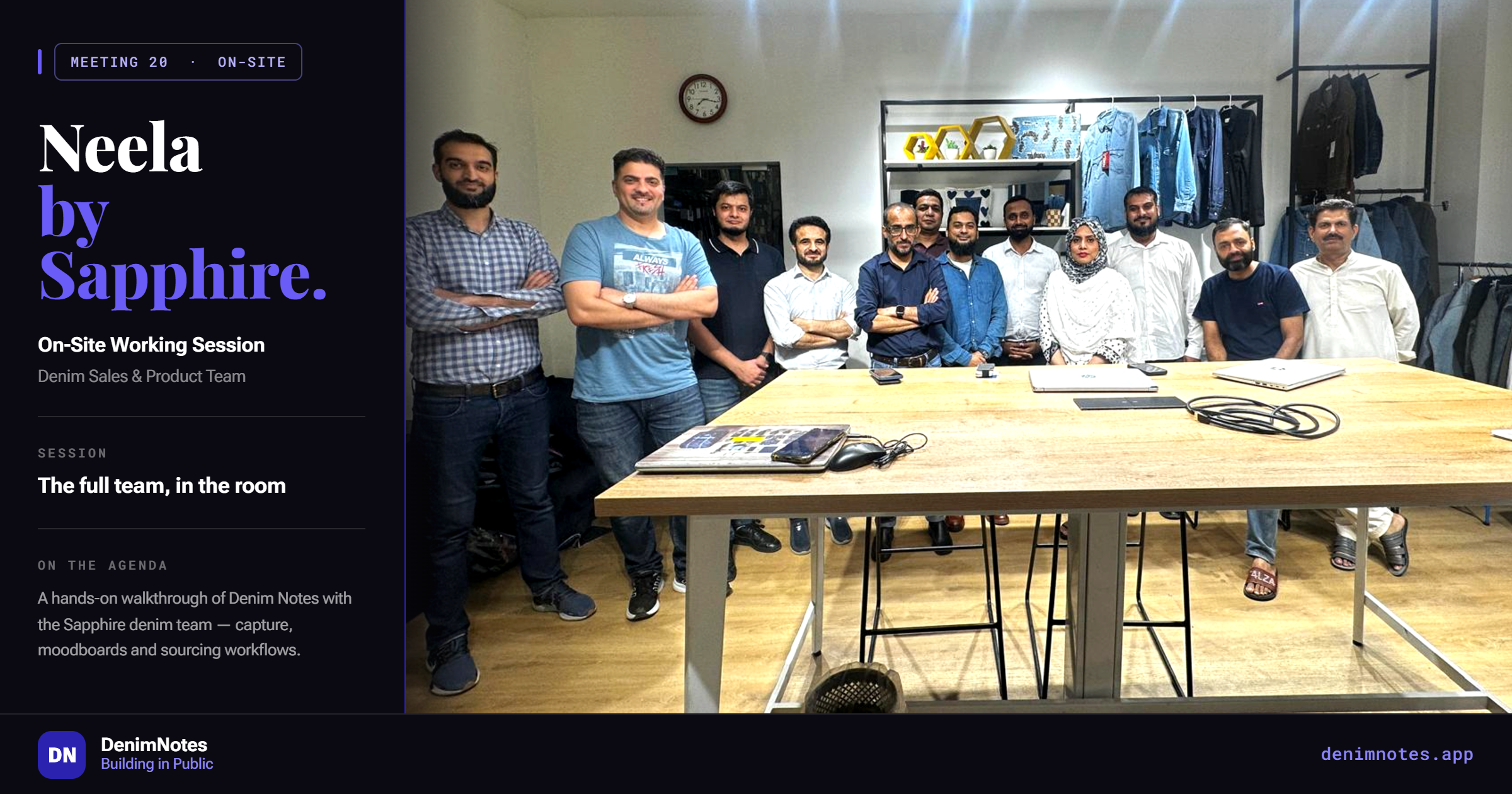
When I arrived for the on-site session, the full Neela Denim Sales and Product team was there. Not a subset. Not a representative. The people who actually do the work — Sales, PD, R&D — together in the same room, at the same time.
Neela made that happen. It made the conversation richer, more honest, and more directly useful for what gets built next.
It also meant that every objection, every question, every workflow edge case came up in real time. There was no "I'll have to check with the sales team" or "PD would need to weigh in on that." The whole picture was in the room. And Ahmed made sure none of us lost the connection when we needed it most — the WiFi hotspot that saved the day.
How DenimNotes Serves Sales, PD, and Management Simultaneously
The session covered the full DenimNotes workflow from the buyer's first interaction with a fabric through to development and beyond. For a team that spans Sales, PD, and R&D, this means different things to different people in the room — and that's exactly the point.
For the Sales team: fabric capture at trade shows, meeting notes logged against the article in real time, buyer interactions searchable months later, follow-ups that don't require reconstructing a conversation from memory.
For the Product Development team: visibility into which articles are generating buyer interest without waiting for a sales briefing. The ability to see — without asking — which fabrics are being selected, which are being queried about price, which have open development requests.
For management: a live picture of the commercial pipeline across every buyer relationship, every article, every stage. Not a report. Not a weekly update. The actual live state of the operation, always visible, never requiring a request.
And for all three functions: the moodboard — a structured, searchable record of fabrics, built with AI, that turns a collection of captures into an intelligent reference that gets more useful over time.
The Institutional Memory Every Mill Needs
One of the most important concepts in the session was institutional memory — the accumulated knowledge of every buyer relationship, every article discussion, every commercial decision a mill has ever made.
In most mills today, this memory is fragile. It lives in individual email inboxes. In WhatsApp threads that scroll out of reach. In notebooks from trade shows that sit in desk drawers. In the mind of a sales rep who leaves the company and takes three years of buyer relationship history with them.
When the rep leaves, the memory leaves. When the buyer follows up on a conversation from eighteen months ago, the mill has to reconstruct it from fragments. When management wants to understand why a key account stalled, there is no record to look at — only whoever was closest to the account and can still remember.
"I hope the Neela Sales, PD and R&D team use this to build the Institutional Memory that helps them in their day to day job."— Umer Farooq Qureshi, Founder, DenimNotes
DenimNotes captures this memory in the moment it happens. Every buyer interaction logged. Every article selection recorded. Every price discussed, every development request raised, every follow-up completed — all of it attached to the article thread, timestamped, searchable, permanent. The memory belongs to the company, not the individual. It compounds over time.
This is what I always wished we'd had at Neela. And this is what I came back to show them.
Closing the First Leg
Meeting 20 is the end of the first leg of Building in Public. Twenty meetings across five weeks — Pakistan's leading denim mills, from Naveena and Artistic Milliners to Azgard 9, AGI Denim, Indigo Textile, Siddiqsons, and now Neela. Each conversation has shaped what DenimNotes is becoming.
Ending the first leg at Neela felt right. Not because it was strategically planned that way, but because there is something fitting about finishing where so much of the thinking started. The problems were named here first. The product exists because of what was learned here. And now the people here have seen what was built from those learnings.
Thank you to Neela by Sapphire for being a fantastic host — and to Ahmed for the life-saving WiFi hotspot. The first leg is done. Building continues.
If you're a denim fabric mill or buyer and want to see what we're building, book a demo. The supplier tier is free for early partners.
- Information asymmetry between Sales, PD, and R&D is the structural problem that DenimNotes was built to solve — and Neela is where that problem was first understood from the inside
- Having the full team in the room — Sales, PD, R&D — produces a qualitatively different conversation than a single-function demo: every edge case surfaces, every workflow is stress-tested in real time
- Real-time information sharing is not about technology — it's about letting the sales team focus on customers instead of chasing internal updates
- Institutional memory is the most durable form of competitive advantage a mill can build — and it compounds only if it's captured systematically from day one
- Meeting 20 closes the first leg: 20 mills, 5 weeks, one clear signal that the problem is real and the product is solving it