Azgard 9: Who They Are
Azgard Nine Limited is one of Pakistan's original denim pioneers. Listed on the Pakistan Stock Exchange, vertically integrated from spinning through garment manufacturing, and working with leading European apparel brands — Azgard 9 has been part of the denim ecosystem in Pakistan since before most of the mills we've spoken to in this series had their first loom running.
Their scale, their technical depth, and their relationships with some of Europe's most demanding fashion buyers put them in a category of their own. When a company like this agrees to sit down with a product that's five weeks into building in public, it means something. They've seen enough tools come and go to know immediately whether something is built for the real world or for a pitch deck.
Week 5: A Full House from PD and Sales
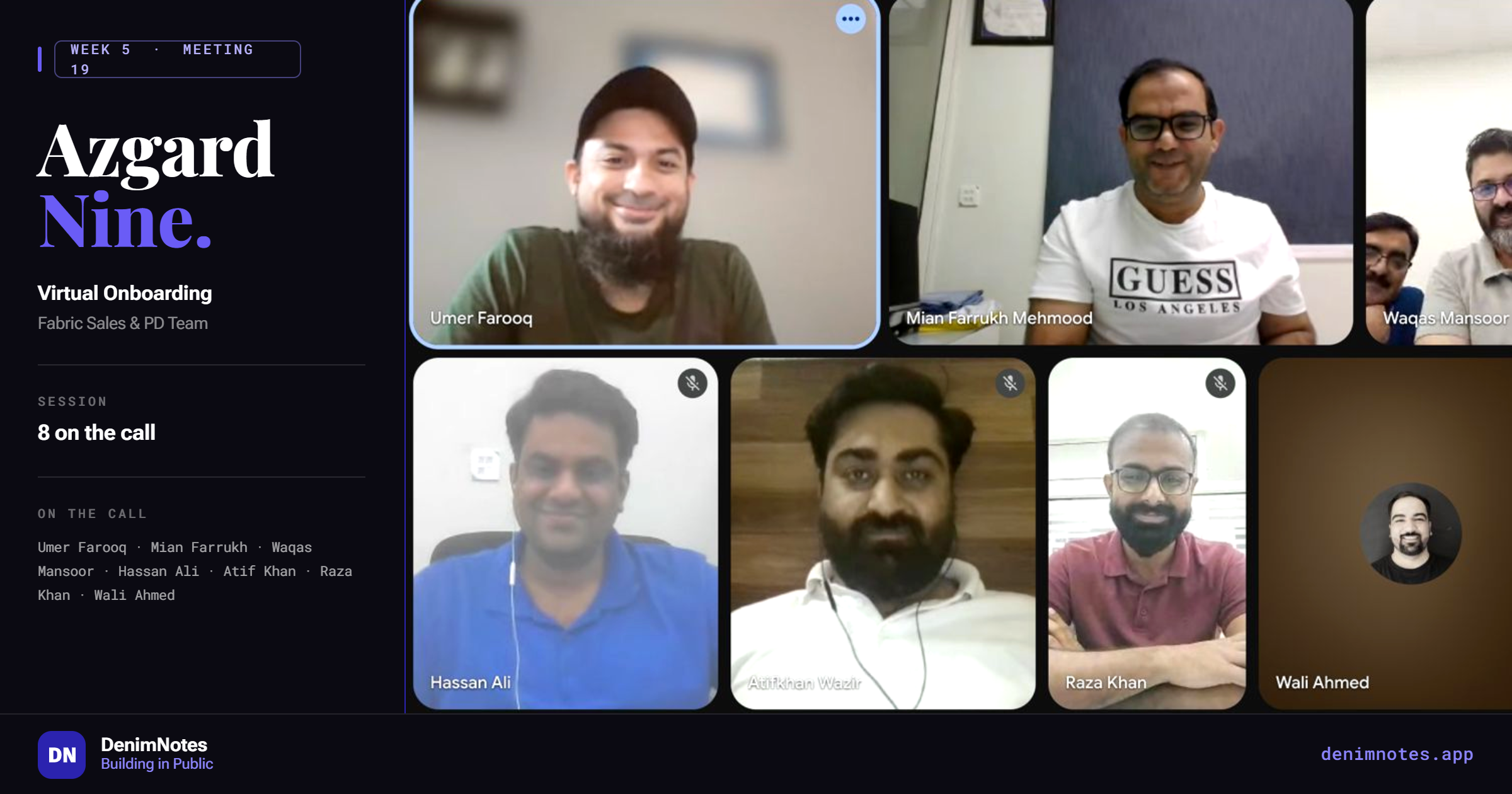
Most onboarding calls have one or two people from the mill side. This one had five. Mian Farrukh Mehmood, Waqas Mansoor, Hassan, Atif, and Raza — representing Product Development and Fabric Sales and Marketing — all joined the call together.
That tells you something. A team doesn't clear five calendars for a product demo unless the people who suggested it have already made the case internally. It meant the conversation was going to be substantive, not exploratory. These were people who knew their own workflow from the inside. They were going to pressure-test what we'd built, not nod politely at a feature list.
Having PD and Sales in the same room — even a virtual one — also meant we could talk about the problem that sits between the two teams: the gap in visibility that makes one side invisible to the other until something goes wrong.
The Information That Scatters
One of the central questions of the call was a simple one: how does a fabric sales rep at Azgard 9 — or any denim mill — currently record a meeting with a buyer?
The answers are always variations of the same theme. A notebook. A voice note to self. A WhatsApp message to a colleague. A mental note that stays mental until something triggers a recall. Sometimes a spreadsheet that's current for a week before it starts drifting from reality. Often nothing at all — because the meeting was rushed, the booth was busy, and there wasn't a moment to stop and write.
"From the first meeting with a buyer, the information starts to scatter. By the time that article reaches bulk, you'd need to reconstruct the commercial history from five different places — if those places still exist."— Umer Farooq Qureshi, Founder, DenimNotes
And what scatters with the notes is everything attached to them. Which articles the buyer showed interest in. What price was discussed. Whether there was a development request, and what stage it's at now. What the buyer said on the follow-up call three weeks later. What was promised. What changed. This is not a record. This is a trail of fragments — and the further you get from the original conversation, the less legible the trail becomes.
The Azgard 9 team knew this pattern. Not in the abstract. From experience. This is the daily reality of a fabric sales team that operates at show floors, in showrooms, on video calls, and through WhatsApp conversations — with no shared system capturing any of it.
Information scatter is not just an inconvenience. It's a structural tax on every buyer relationship. Follow-ups take longer. Pricing discussions get repeated. Development stages have to be explained again. Buyers lose confidence when the mill can't immediately confirm what was discussed. And management, trying to understand why an account stalled, has no usable record to look at.
DenimNotes was built to eliminate this tax — by capturing everything on the article, at the moment it happens, without requiring a separate logging step.
Built Around How Sales Teams Actually Work
The conversation at Azgard 9 went somewhere that most onboarding calls take a while to reach: the question of whether a tool is built around how a system thinks sales teams should work, or how they actually work.
Most sales tools are built for desk environments, by people who have never worked a trade show floor. They assume the rep has time to open a laptop, find the right record, fill in the fields, and save before the next buyer arrives. At Kingpins or Première Vision, the reality is the opposite. A buyer walks in, picks up an article, asks about price and lead time, and walks out — in under four minutes. The rep who tries to log that interaction on a CRM while it's happening loses the buyer. The rep who decides to log it later loses the information.
DenimNotes is mobile-first, offline-capable, and built around the article rather than the account. A sales rep at a trade show taps the article, adds a note — "Buyer X, interested in colourway 3, asked about 500m MOQ, price TBC" — and it's done. The entire conversation is attached to that article's thread. When the buyer follows up three weeks later, the rep opens the thread and has the complete picture in under ten seconds.
This is what it means to build around how sales teams actually work. Not how a business analyst decided they should work. Not how it looks on a process diagram. How it works at 4pm on a busy show floor with six buyers waiting.
One Thread, From Selection to Bulk
One of the features the Azgard 9 team found most compelling was the collaboration layer — what happens once a buyer moves from interest to selection.
In the traditional workflow, selection is when the information problem gets worse, not better. The buyer has confirmed interest. Now pricing needs to be finalised, samples need to be sent, development needs to be tracked, proto approvals need to happen, and all of this has to somehow be communicated across two organisations — the mill and the brand — through whatever channels each side happens to prefer. Email for some things. WhatsApp for others. A shared spreadsheet that one party updates and the other never opens. Phone calls that have no written record.
DenimNotes handles this by bringing the buyer into the article thread directly. Once a selection is confirmed, the buyer gets access to the same record the mill is working from. Pricing updates, sample confirmations, development feedback, proto approvals, and bulk confirmation all happen on the thread. Both sides see the same information, at the same time, with a complete history of how the conversation evolved from the first selection through to bulk.
"Everything from selection, pricing, sampling, proto, and bulk gets discussed and tracked in one place. The mill team knows where it stands. The buyer knows what's happening. No one has to ask."— Umer Farooq Qureshi, Founder, DenimNotes
For a mill like Azgard 9, which manages relationships with buyers from demanding European brands, this matters more than it might for a smaller operation. The buyers they work with have expectations about response time, accuracy, and transparency. A thread that gives both parties a shared record of everything discussed — from initial selection to bulk confirmation — is not a nice-to-have. It's the foundation of a professional relationship at the level these accounts demand.
They Loved It. Then Asked to Make It Better.
The call ended the way the best calls in this series end: with the room on the same page, the energy still high, and a sense that we had talked about something real — not features, not a pitch, but the actual problem and what it would mean to solve it properly.
Mian Farrukh, Waqas, and the team were engaged throughout. Not politely engaged — genuinely so. The kind of engagement that shows up when a group recognises something in a product that maps directly onto their own experience. They pushed back on things. They asked specific questions. That's how you know the conversation has gone past the demo and into the product.
And because I know this team personally — built a relationship over years in the denim industry, not just through a cold outreach — I asked for something I wouldn't typically ask in a first meeting. I asked for their feedback. Not a polite summary. Specific, critical, honest feedback about what was missing, what was confusing, and what they'd want to see built next.
They said yes.
That's the whole value of Building in Public with mills you actually know. The feedback you get from a friendly face who understands the industry is qualitatively different from what you'd get from a structured user test or a survey. It comes from a place of wanting the product to succeed — and from a depth of domain knowledge that no external research can replicate.
If you're a denim fabric mill or buyer who recognised yourself in any part of this conversation, book a demo. The mill tier is free for early partners. The only cost is honest feedback — and that's exactly the currency this product is being built on.
- Five people from PD and Fabric Sales joined — the fullest house of any call in the series so far, and a signal that the internal case had already been made before the demo started
- The information scatter problem is real across the entire sales cycle — from the first meeting at a trade show through pricing, development, and bulk — and the Azgard 9 team knew it from lived experience
- DenimNotes being built around how sales teams actually work — mobile-first, offline-capable, organised around the article not the account — was the specific design decision that resonated most
- The collaboration feature, bringing buyers into a shared thread from selection to bulk, addressed the exact moment where information scatter gets most expensive: when two organisations are supposed to be working from the same record but aren't
- Personal relationships unlock a different quality of feedback — the kind that comes from genuine investment in the product's success, not from politeness