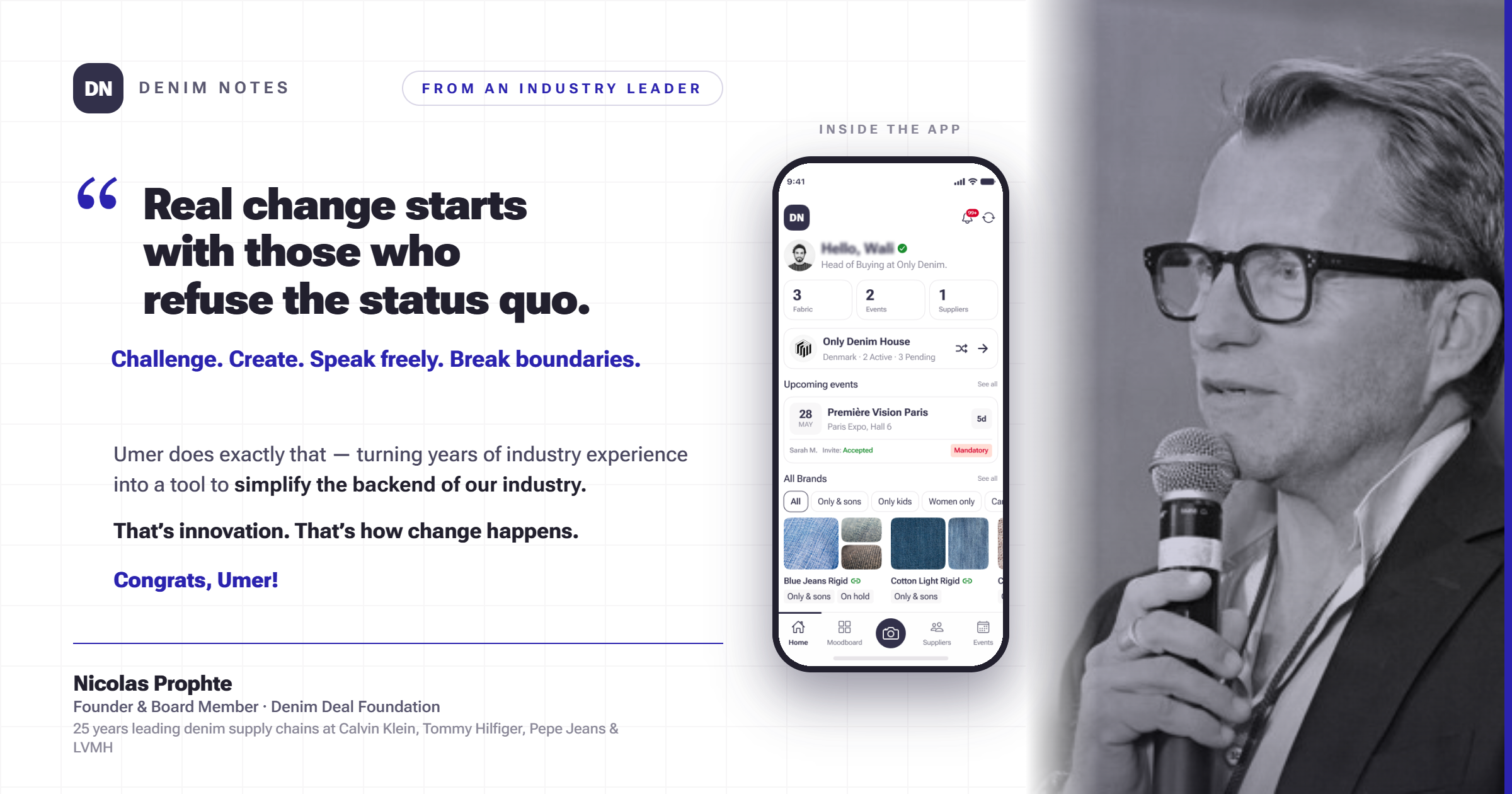
What Nicolas Prophte Wrote About DenimNotes
Some things are better heard in full than summarised. So here is what Nicolas Prophte wrote:
Umer does exactly that — turning years of industry experience into a tool to simplify the backend of our industry.
That's innovation. That's how change happens."
25 years at Calvin Klein, Tommy Hilfiger, Pepe Jeans & LVMH
Who Nicolas Prophte Is
Nicolas Prophte has spent 25 years inside the global denim supply chain — not as an observer, but as someone making decisions at the highest level. Calvin Klein. Tommy Hilfiger. Pepe Jeans. LVMH. Four of the most influential brands in the history of denim, at a level where you see every layer of the supply chain, from mill to shelf, up close.
After those years in brand leadership, Nicolas founded the Denim Deal Foundation — an industry-wide initiative that brings together brands, mills, and organisations to accelerate the transition to sustainable denim production. The Denim Deal's work is about shared accountability: creating frameworks where every player in the supply chain measures the same things, reports honestly, and moves together.
When someone who has sat at the intersection of brand and supply chain for 25 years — who has seen what works and what doesn't from the inside — looks at what you've built and says "that's how change happens," it is not a polite comment. It is a diagnosis.
What He Means by "the Backend"
Most people outside denim don't see the layer Nicolas is describing when he says "simplify the backend of our industry."
The visible layer of the denim industry is what ends up on the shelf: the finished garment, the wash, the fabric quality, the price point. The invisible layer — the backend — is everything that happened to get there. Which mills were considered. Which fabrics were shortlisted at Kingpins. Which samples were developed and then dropped. Which buyer asked for a price and never followed up. Which commercial conversation happened four months before a collection brief landed.
Nobody writes this down. It lives in the memories of individuals, in WhatsApp threads, in voice notes from trade show floors, in notebooks that don't survive team changes. Every time a sales rep moves, a buyer changes roles, or a season ends, the commercial history of hundreds of conversations evaporates.
"The backend of the denim industry is where value is created — and it has never had a proper system to capture it. Until now."— Umer Farooq Qureshi, Founder, DenimNotes
DenimNotes captures the backend. Every article selection, every meeting note, every development conversation, every buyer interaction — structured, searchable, permanent. The commercial intelligence that currently disappears between seasons stays in one place and compounds over time.
Why the Brand Side's Diagnosis Carries More Weight
User validation is one kind of evidence — and 20 meetings across Pakistan's leading mills have delivered that. But there is a different kind of validation that comes from someone who has seen the whole industry from the brand side.
Nicolas Prophte has watched from the brand side — and from the foundation side — as the supply chain struggled with exactly the problem DenimNotes is built to solve. Information that never gets captured. Development work that never gets credited. Commercial relationships that exist only in email inboxes. The entire Tier 2 layer of the supply chain operating on goodwill and memory rather than systems.
When he says "turning years of industry experience into a tool to simplify the backend of our industry" — that phrase "years of industry experience" is the key. DenimNotes isn't built by someone who studied the problem from the outside. It's built by someone who lived it, watched it, and understood specifically what was missing. Nicolas recognises that because he has the same vantage point from the brand side.
"Challenge. Create. Speak freely. Break boundaries."— Nicolas Prophte, Denim Deal Foundation
Kingpins Amsterdam and the Global Expansion
The first leg of Building in Public is complete — 20 meetings, Pakistan's leading mills, a platform being tested in real commercial workflows. Nicolas Prophte's endorsement closes that chapter and opens the next one.
Kingpins Amsterdam is next. International buyers from Europe and North America. Mills from Turkey, Portugal, Bangladesh, and beyond. The same problem — the backend of the denim industry, undocumented and fragmented — exists everywhere the industry operates. DenimNotes is built to solve it everywhere it does.
What changes at Kingpins: buyer behaviour in a European trade show context, where the language, collection timelines, and compliance requirements differ from the Pakistan supply chain. What stays the same: the article-level capture, the post-show follow-up gap, the management visibility problem. These are structural. They don't vary by geography.
To every mill and buyer who wants to be part of what comes next: book a demo. The platform is free for early partners.
- Nicolas Prophte has 25 years inside denim supply chains across Calvin Klein, Tommy Hilfiger, Pepe Jeans, and LVMH — he knows the backend problem from the brand side
- As Founder of the Denim Deal Foundation, he has spent years trying to create shared accountability frameworks across the industry — DenimNotes is the missing data layer
- "Simplify the backend of our industry" is a precise description of what DenimNotes does — coming from someone who has watched that backend operate for 25 years, it's a diagnosis, not a compliment
- The Building in Public series has generated 20 mills in one leg — this is the signal that the next leg goes global